Wigner-D matrix
Definition
In this package we use the following definition for Wigner D-matrices \(D^l_{m,n}(\alpha,\beta,\gamma)\) as function of euler angles \(\alpha,\beta,\gamma\), using the \(ZYZ\) convention.
\[
D^l_{m,n}(\alpha,\beta,\gamma) = e^{-im\alpha} d^l_{m,n}(\beta) e^{-in\gamma}
\]
\[
d^l_{m,n}(\beta) = A_l(-1)^{(m-n+\mu)/2}\sqrt{\frac{s!(s+\mu+\nu)!}{(s+\mu)!(s+\nu)!}} \left(\sin\frac{\beta}{2}\right)^\mu \left(\cos\frac{\beta}{2}\right)^\nu P^{\mu,\nu}_s(\cos\beta)
\]
where \(\mu=|m-n|,\ \nu=|m+n|,\ s=l-\frac{\mu+\nu}{2},\quad P^{\mu,\nu}_s\) are Jacobi polynomials and \(A_l=\sqrt{\frac{2l+1}{2}}\) is an optional normalization term.
Symmetries
Not all of the values of \(d^l_{m,n}(\beta)\) are independent. PySOFFT uses the following symmeries to reduce the number of elements to compute by a factor of 8.
\[
\begin{aligned}
d^l_{m,n}(\beta)&= d^l_{-n,-m}(\beta)\\
d^l_{m,n}(\beta)&=(-1)^{m-n}d^l_{n,m}(\beta)\\
d^l_{m,n}(\beta)&=(-1)^{l+2m-n}d^l_{m,-n}(\pi-\beta)
\end{aligned}
\]
In order to take advantage of the last symmetry we have to use a \(\pi\) symmetric sampling of \(\beta\). In that case we only need to compute the values of \(d^l_{m,n}(\beta)\) for \(0\leq m \leq n \leq l < \mathrm{bw}\) for a given bandwith \(\mathrm{bw}\).
Computation via Recurrence
PySOFFT implements two different recursion based computation routines for Wigner small-d matrices.
Kostelec recurrence
Note
The basic idea given in Kostelecs paper(pdf) is to use known values for \(d^n_{m,n}(\beta)\) to start a three term recurrence in \(l\) that allows to compute Wigner \(d^l_{m,n}\) at \(l+1\) from known values at \(l-1\) and \(l\), i.e.:
\[
\{d^{l-1}_{m,n}(\beta),d^{l}_{m,n}(\beta)\} \longrightarrow d^{l+1}_{m,n}(\beta)
\]
The recursion start is given by the equation
\[
d^n_{m,n}(\beta) = \sqrt{\frac{2n+1}{2}} \sqrt{\frac{2n!}{(n+m)!(n-m)!}} \cos\left(\frac{\beta}{2}\right)^{n+m} \sin\left(\frac{\beta}{2}\right)^{n-m}
\]
To compute this relation PySOFFT employs the following recursion formulas
\[
\begin{aligned}
n,m-1 &\rightarrow n+1,m & {d^{n+1}_{m,n+1}}(\beta)&={d^n_{m-1,n}}\sqrt{\frac{(2n+2)(2n+3)}{(n+m)(n+m+1)}} \cos(\frac{\beta}{2})^2 \\
n,m &\rightarrow n+1,m & d^{n+1}_{m,n+1}(\beta)&=d^l_{m,n}\sqrt{\frac{(2n+2)(2n+3)}{(n+m+1)(n-m+2)}} \cos(\frac{\beta}{2}) \sin(\frac{\beta}{2})
\end{aligned}
\]
Starting from \(d^{0}_{0,0}(\beta)=\sqrt{\frac{1}{2}}\) (i.e. the normed definition of \(d^l_{m,n}\) these two recursion formulas are applied according to the following scheme
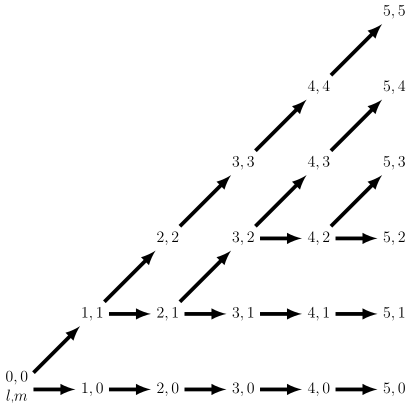

This recursion is implemented in compute_all_dlml_l_contiguous.
Based on these vales we can use a three-term recurrence formulat to sucessively increas the order and compute all remaining values for
for \(0\leq m \leq n\), the following recurrence is used to compute all \(d^l_{mn}\) for \(m \leq n \leq l<bw\).
\[\begin{aligned}
 d^{l+1}_{mn}(\beta) = \sqrt{\frac{2l+3}{2l+1}} \frac{(l+1)(2l+1)}{\sqrt{\left[(l+1)^2-m^2\right]\left[(l+1)^2-n^2\right]}} \left(\cos\beta -\frac{mn}{l(l+1)}\right)\ &d^l_{mn}(\beta) \\
                     -\quad \sqrt{\frac{2l+3}{2l-1}} \frac{\sqrt{[l^2-m^2][l^2-n^2]}}{\sqrt{\left[(l+1)^2-m^2\right]\left[(l+1)^2-n^2\right]}}\frac{l+1}{l}\ &d^{l-1}_{mn}(\beta)
\end{aligned} \]
All other Wigner-d matrix elements are connected to these values by symmetries.
Kostelec recurrence is currently the default option and is used when you instanciate a transform object as follwos
from pysofft import Soft
bw = 32
s = Soft(bw)
# or equivalently
s = Soft(bw,recurrence_type=Soft.recurrence_types.kostelec)
Advantages of Kostelec recurrence in PySOFT
Speed
This recurrence does not mix different \(m,n\) values it this allows to compute the wigner transforms conceptually as follows
for m=0,bw-1
    for n=m, bw-1
        !compute all relevant wigners
        d_mn = ...
        !Perform wigner transform
        flmn = matmul(f,d_mn)
compute \(d^l_{m,n}\) for fixed \(l\).
If you want to compute a full Wigner small-d matrix at fixed \(l\) for some \(\beta\) you can do so via
from pysofft import wigner as wig
import numpy as np
l=32
betas = np.array([np.pi*4/11,np.pi-np.pi*4/11])
normalization = False
assert np.allclose(np.pi-betas,betas[::-1]), 'np.pi -betas musst be the same as betas[::1] because of the used symmetries.'

dlmn = wig.wigner_dl_kostelec(l,betas,normalization)

print(f'{dlmn.shape} (betas,m,n)')
# Check that dlmn is Orthogonal as it should be
np.allclose(dlmn[0]@dlmn[0].T,np.eye(2*l+1))
genwig_all_kostelec or the implementation of wigner_dl_kostelec together with wig_l_recurrence_kostelec.
Stability at l < 600
See accuracy for details. For certain \(\beta\) values and \(l > 600\) the recurrence seems to brake down. I currently dont fully understand why, my best guess is that the recursion start \(d^n_{m,n}(\beta)\) has true values lower than double precission (\(< \sim 10^{-308}\)).
Risbo recurrence
The recurrence givnen in Risbos paper starts from \(d^1_{m,n}\) for all \(m,n\):
\[\begin{bmatrix}
    \cos(\frac{\beta}{2}) & -\sqrt{3}\cos(\frac{\beta}{2})\sin(\frac{\beta}{2}) & \sin(\frac{\beta}{2})^2\\
    \sqrt{3}\cos(\frac{\beta}{2})\sin(\frac{\beta}{2}) & \cos(\frac{\beta}{2})-\sin(\frac{\beta}{2})^2 & -\sqrt{3}\cos(\frac{\beta}{2})\sin(\frac{\beta}{2})\\
    \sin(\frac{\beta}{2})^2 & \sqrt{3}\cos(\frac{\beta}{2})\sin(\frac{\beta}{2}) & \cos(\frac{\beta}{2})
\end{bmatrix}    \]
and then increases the degree \(l-\frac{1}{2} \rightarrow l\) via
\[
\begin{aligned}
    d^{l+\frac{1}{2}}_{m,n}(\beta) &=  d^{l-\frac{1}{2}}_{m-1,n-1}(\beta) \frac{\sqrt{(l+m)(l+n))}}{2l}\cos(\frac{\beta}{2}) \\
                                   &  -d^{l-\frac{1}{2}}_{m-1,n}(\beta) \frac{\sqrt{(l+m)(l-n)}}{2l}\sin(\frac{\beta}{2}) \\
                                   &  +d^{l-\frac{1}{2}}_{m,n-1}(\beta) \frac{\sqrt{(l-m)(l+n)}}{2l}\sin(\frac{\beta}{2}) \\
                                   &  +d^{l-\frac{1}{2}}_{m,n}(\beta) \frac{\sqrt{(l-m)(l-n)}}{2l}\cos(\frac{\beta}{2})
\end{aligned}
\]
graphically this can be represented as follows:
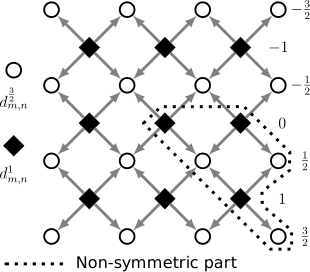
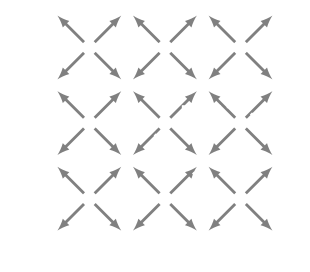
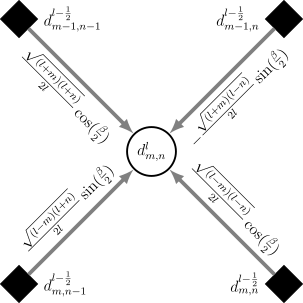
On the left you can see the how the recurrence looks for the example of \(d^{1}_{m,n} \rightarrow d^{\frac{3}{2}}_{m,n}\). On the right is a graphical representation of the recurrence kernel that has been given in the equation from above.
Risbo recurrence can be used when you instanciate a transform object as follwos
from pysofft import Soft
bw = 32
s = Soft(bw,recurrence_type=Soft.recurrence_types.risbo)
Advantages of Risbo recurrence in PySOFT
Precission
The Risbo recurrence has higher acurracy at high \(l\) and does not brake down for \(l>600\), for details see accuracy.
compute \(d^l_{m,n}\) for fixed \(l\).
If you want to compute a full Wigner small-d matrix at fixed \(l\) for some \(\beta\) you can do so via
from pysofft import wigner as wig
import numpy as np
l=32
betas = np.array([np.pi*4/11,np.pi-np.pi*4/11])
normalization = False
assert np.allclose(np.pi-betas,betas[::-1]), 'np.pi -betas musst be the same as betas[::1] because of the used symmetries.'

dlmn_red = wig.wigner_dl_risbo_reduced(l,betas,normalization)
dlmn = wig.sym_reduced_to_full_wigner(dlmn,l)

print(f'{dlmn.shape} (betas,m,n)')
# Check that dlmn is Orthogonal as it should be
np.allclose(dlmn[0]@dlmn[0].T,np.eye(2*l+1))
genwig_all_risbo the implementation of wigner_dl_risbo_reduced and wigner_recurrence_risbo_reduced.