Performance metrics
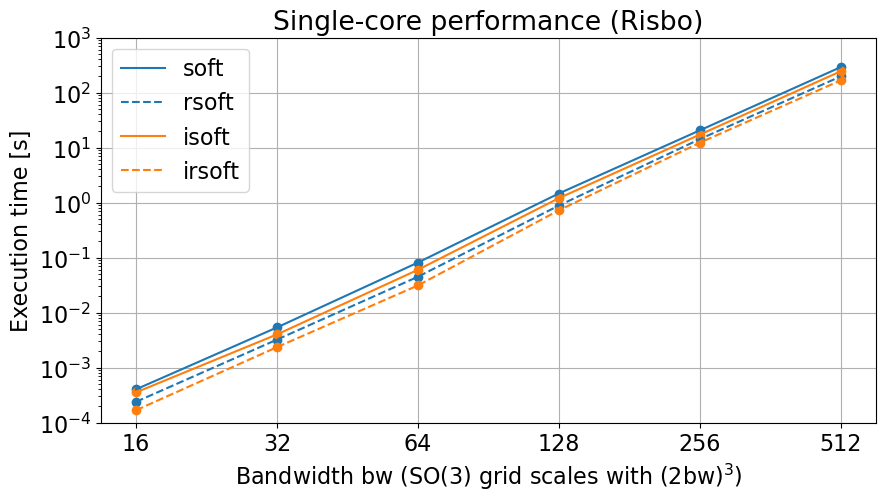
The following performence metric where generated on a compute node with two AMD EPYC 7543, a total of 64 physical CPU cores and 512GB of RAM. Results are shown for both Kostelec and Risbo recurrence shemes.
on-the-fly computation VS. precomputed Wigners
All results on this site where generated using the on-the-fly computation of Wigner matrices.
The precomputed variants give a slight speed increase and eliminate all performance differences between Kostelec and Risbo reccurences.
Memory consumption becomes a nightmare though. The number of Wigner coefficients scales with \(O(\mathrm{bw}^4)\) and their required memory reaches \(~180\,\)GB at bw = 512.
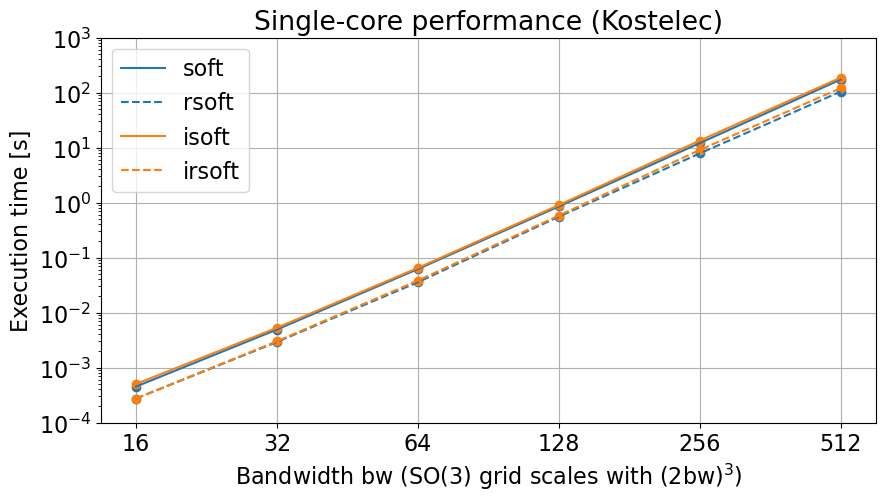
Kostelec recurrence
| method\bw | 16 | 32 | 64 | 128 | 256 | 512 |
|---|---|---|---|---|---|---|
| soft | \(450\mu\)s \(\pm 1\mu\)s | \(4.91\)ms \(\pm 0.05\)ms | \(61.6\)ms \(\pm 0.3\)ms | \(0.8466\)s \(\pm 0.0006\)s | \(12.0\)s \(\pm 0.4\)s | \(172\)s \(\pm 4\)s |
| isoft | \(501\mu\)s \(\pm 4\mu\)s | \(5.28\)ms \(\pm 0.02\)ms | \(64.6\)ms \(\pm 0.2\)ms | \(0.8962\)s \(\pm 0.0006\)s | \(13.328\)s \(\pm 0.004\)s | \(186\)s \(\pm 1\)s |
| rsoft | \(273\mu\)s \(\pm 2\mu\)s | \(2.917\)ms \(\pm 0.004\)ms | \(35.5\)ms \(\pm 0.2\)ms | \(0.5517\)s \(\pm 0.0001\)s | \(7.8\)s \(\pm 0.2\)s | \(103.7\)s \(\pm 0.7\)s |
| irsoft | \(273\mu\)s \(\pm 2\mu\)s | \(3.01\)ms \(\pm 0.02\)ms | \(38.1.6\)ms \(\pm 0.2\)ms | \(0.5783\)s \(\pm 0.0002\)s | \(9.00\)s \(\pm 0.07\)s | \(120\)s \(\pm 1\)s |
Risbo recurrence
| method\bw | 16 | 32 | 64 | 128 | 256 | 512 |
|---|---|---|---|---|---|---|
| soft | \(401\mu\)s \(\pm 2\mu\)s | \(5.35\)ms \(\pm 0.04\)ms | \(81.0\)ms \(\pm 0.3\)ms | \(1.457\)s \(\pm 0.009\)s | \(20.46\)s \(\pm 0.02\)s | \(172\)s \(\pm 4\)s |
| isoft | \(353\mu\)s \(\pm 1\mu\)s | \(4.00\)ms \(\pm 0.03\)ms | \(60\)ms \(\pm 1\)ms | \(1.197\)s \(\pm 0.009\)s | \(17.11\)s \(\pm 0.02\)s | \(186\)s \(\pm 1\)s |
| rsoft | \(238\mu\)s \(\pm 1\mu\)s | \(3.21\)ms \(\pm 0.03\)ms | \(44.7\)ms \(\pm 0.2\)ms | \(0.878\)s \(\pm 0.001\)s | \(14.18\)s \(\pm 0.02\)s | \(103.7\)s \(\pm 0.7\)s |
| irsoft | \(133\mu\)s \(\pm 1\mu\)s | \(2.34\)ms \(\pm 0.03\)ms | \(31.0\)ms \(\pm 0.2\)ms | \(0.720\)s \(\pm 0.001\)s | \(12.19\)s \(\pm 0.06\)s | \(120\)s \(\pm 1\)s |
The given errors are simply the standard deviations of the datasets computed by the code below.
Code: Single-core speed test
WARNING: The bw=512 computation uses \(\sim 70\)GB of RAM and bw=256 uses \(\sim 8\)GB. Depending on your PC you might need to skip these.
from pysofft import Soft
import pysofft
import timeit
import numpy as np

soft_execution_times=[[],[]]
rsoft_execution_times=[[],[]]
isoft_execution_times=[[],[]]
irsoft_execution_times=[[],[]]
for bw in [16,32,64,128,256,512]:
    for recurrence_type in [0,1]:
        # instanciating Soft class + generating in/out arrays
        s = Soft(bw,init_ffts=True,
                 use_fftw_wisdom=True,
                 fftw_flags=pysofft._soft.softclass.fftw_measure,
                 precompute_wigners=False,
                 recurrence_type=recurrence_type)
        coeff = s.get_coeff(random=True)
        coeffr = s.get_coeff(random=True,real=True)
        func = s.get_so3func()
        funcr = s.get_so3func(real=True)
        if recurrence_type==0:
            recurrence = 'Kostelec'
        else:
            recurrence = 'Risbo'
        # speed tests
        tmpi = np.array(timeit.repeat('s.isoft(coeff,out = func)',number=10,repeat=7,globals=globals()))/10
        isoft_execution_times[recurrence_type].append(tmpi)
        tmpir = np.array(timeit.repeat('s.irsoft(coeffr, out = funcr)',number=10,repeat=7,globals=globals()))/10
        irsoft_execution_times[recurrence_type].append(tmpir)
        tmp = np.array(timeit.repeat('s.soft(func,out = coeff)',number=10,repeat=7,globals=globals()))/10
        soft_execution_times[recurrence_type].append(tmp)
        tmpr = np.array(timeit.repeat('s.rsoft(funcr, out = coeffr)',number=10,repeat=7,globals=globals()))/10
        rsoft_execution_times[recurrence_type].append(tmpr)
        np.save(f"soft_{recurrence}.npy",soft_execution_times[recurrence_type])
        np.save(f"rsoft_{recurrence}.npy",rsoft_execution_times[recurrence_type])
        np.save(f"isoft_{recurrence}.npy",isoft_execution_times[recurrence_type])
        np.save(f"irsoft_{recurrence}.npy",irsoft_execution_times[recurrence_type])
Memory consumption
The memory consumption (in Byte) of individual transforms roughly scales with
\[
  64 (2\ \mathrm{bw})^3
\]
Note that \((2\ \mathrm{bw})^3\) is the number of SO(3) grid points for a given bandwidth. In paticular this is much lower than the number of Wigner-D matrix elements involvend in the trasform, which scales with \(O(\mathrm{bw}^4)\).
Multi-core performance
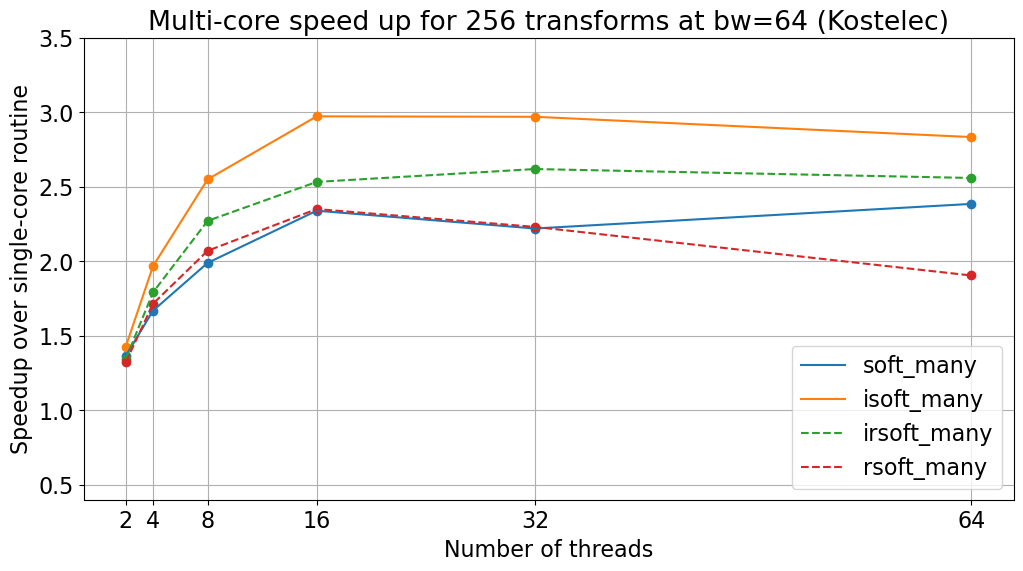
PySOFFT allows parallelization in two different ways:
1. Compute transforms for many datasets in parallel.
2. Speed up individual transforms (Currently no parallel executions of the FFT part)
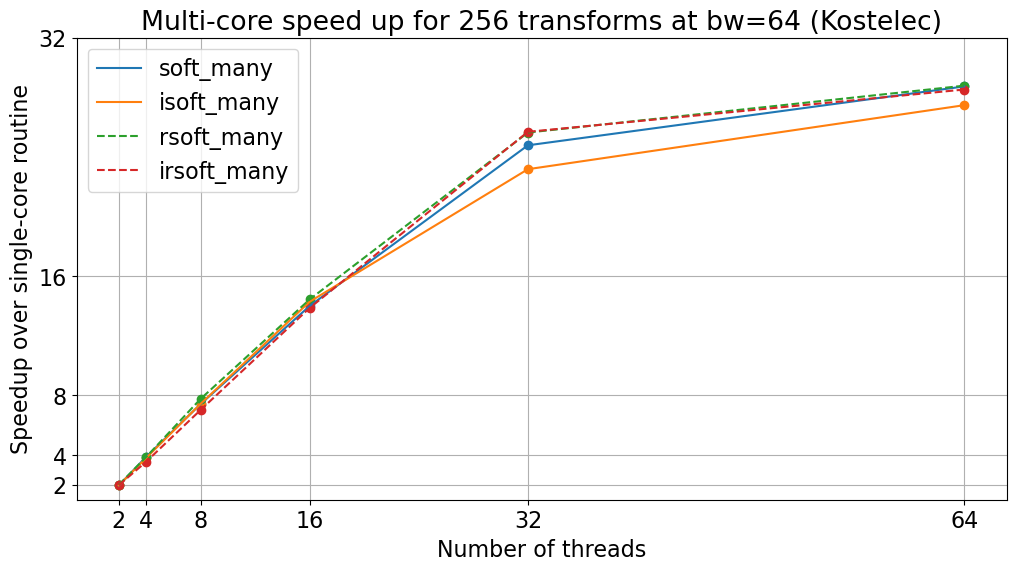
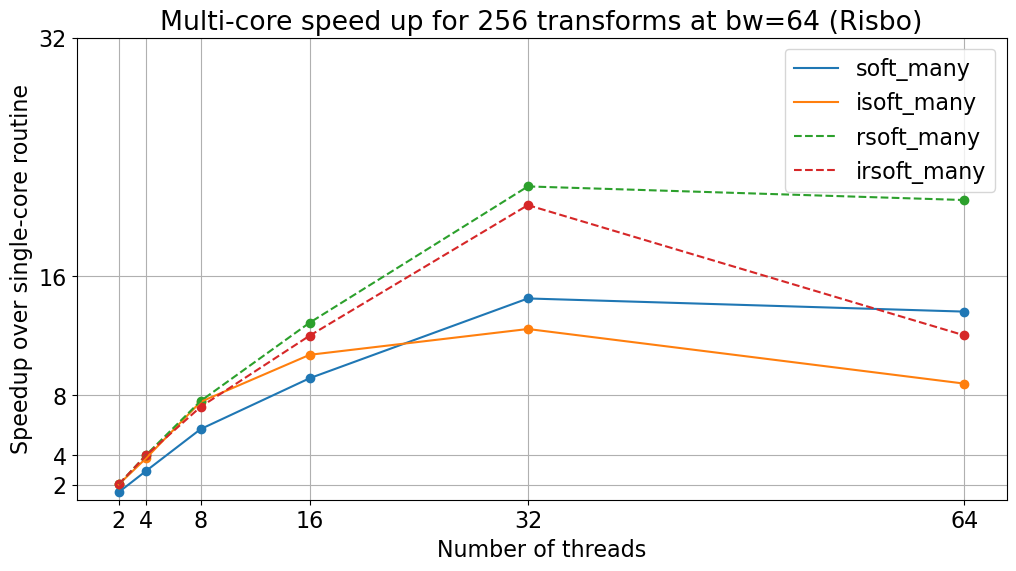
Code: Multi-core multi-transform speed test
import pysofft
from pysofft import Soft
import timeit
import numpy as np

soft_execution_times=[[],[]]
rsoft_execution_times=[[],[]]
isoft_execution_times=[[],[]]
irsoft_execution_times=[[],[]]
bw = 64
N = 256
for nthreads in [1,2,4,8,16,32,64]:
    for recurrence_type in [0,1]:
        # instanciating Soft class + generating in/out arrays
        s = Soft(bw,init_ffts=True,
                 use_fftw_wisdom=True,
                 fftw_flags=pysofft._soft.softclass.fftw_measure,
                 precompute_wigners=False,
                 recurrence_type=recurrence_type)

        pysofft.omp.set_num_threads(nthreads)
        coeff = s.get_coeff(random=True,howmany=N)
        coeffr = s.get_coeff(random=True,real=True,howmany=N)
        func = s.get_so3func(howmany=N)
        funcr = s.get_so3func(real=True,howmany=N)
        print(nthreads)
        if recurrence_type==0:
            recurrence = 'Kostelec'
        else:
            recurrence = 'Risbo'
        print('alive')
        tmp = np.array(timeit.repeat('s.isoft_many(coeff,out = func,use_mp=True)',number=10,repeat=1,globals=globals()))/10
        isoft_execution_times[recurrence_type].append(tmp)
        tmpr = np.array(timeit.repeat('s.irsoft_many(coeffr, out = funcr,use_mp=True)',number=10,repeat=1,globals=globals()))/10
        irsoft_execution_times[recurrence_type].append(tmpr)
        tmp = np.array(timeit.repeat('s.soft_many(func,out = coeff,use_mp=True)',number=10,repeat=1,globals=globals()))/10
        soft_execution_times[recurrence_type].append(tmp)
        tmpr = np.array(timeit.repeat('s.rsoft_many(funcr, out = coeffr,use_mp=True)',number=10,repeat=1,globals=globals()))/10
        rsoft_execution_times[recurrence_type].append(tmpr)

        np.save(f"soft_{recurrence}_mp_many.npy",soft_execution_times[recurrence_type])
        np.save(f"rsoft_{recurrence}_mp_many.npy",rsoft_execution_times[recurrence_type])
        np.save(f"isoft_{recurrence}_mp_many.npy",isoft_execution_times[recurrence_type])
        np.save(f"irsoft_{recurrence}_mp_many.npy",irsoft_execution_times[recurrence_type])
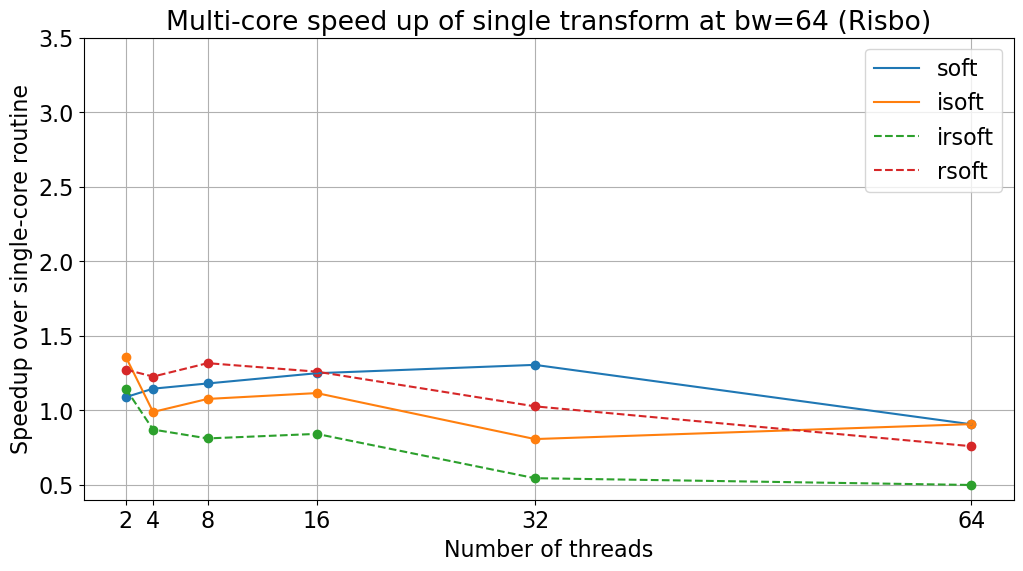
Code: Multi-core single-transform speed test
import pysofft
from pysofft import Soft
import timeit
import numpy as np

soft_execution_times=[[],[]]
rsoft_execution_times=[[],[]]
isoft_execution_times=[[],[]]
irsoft_execution_times=[[],[]]
bw = 64
for nthreads in [1,2,4,8,16,32,64]:
    for recurrence_type in [0,1]:
        # instanciating Soft class + generating in/out arrays
        s = Soft(bw,init_ffts=True,
                 use_fftw_wisdom=True,
                 fftw_flags=pysofft._soft.softclass.fftw_measure,
                 precompute_wigners=False,
                 recurrence_type=recurrence_type)

        pysofft.omp.set_num_threads(nthreads)
        coeff = s.get_coeff(random=True)
        coeffr = s.get_coeff(random=True,real=True)
        func = s.get_so3func()
        funcr = s.get_so3func(real=True)
        print(nthreads)
        if recurrence_type==0:
            recurrence = 'Kostelec'
        else:
            recurrence = 'Risbo'
        print('alive')
        tmp = np.array(timeit.repeat('s.isoft(coeff,out = func,use_mp=True)',number=10,repeat=7,globals=globals()))/10
        isoft_execution_times[recurrence_type].append(tmp)
        tmpr = np.array(timeit.repeat('s.irsoft(coeffr, out = funcr,use_mp=True)',number=10,repeat=7,globals=globals()))/10
        irsoft_execution_times[recurrence_type].append(tmpr)
        tmp = np.array(timeit.repeat('s.soft(func,out = coeff,use_mp=True)',number=10,repeat=7,globals=globals()))/10
        soft_execution_times[recurrence_type].append(tmp)
        tmpr = np.array(timeit.repeat('s.rsoft(funcr, out = coeffr,use_mp=True)',number=10,repeat=7,globals=globals()))/10
        rsoft_execution_times[recurrence_type].append(tmpr)

        np.save(f"soft_{recurrence}_mp_single.npy",soft_execution_times[recurrence_type])
        np.save(f"rsoft_{recurrence}_mp_single.npy",rsoft_execution_times[recurrence_type])
        np.save(f"isoft_{recurrence}_mp_single.npy",isoft_execution_times[recurrence_type])
        np.save(f"irsoft_{recurrence}_mp_single.npy",irsoft_execution_times[recurrence_type])